Saturday, 18 March 2017

Being Mortal


     Author                        Atul Gawande

     Country                      United States

     Genre                          Non Fiction

     Publication Date        October, 2014

     Pages                           263


I have recently started a book club with my college friends and this was our first picks. Hence, it was very special to me! Having vaguely heard about this book before, I had never found the courage to pick this up (yes - you need courage to read a book!). But I am delighted to share that this was not only a great read, but also very enlightening and enriching.
 
Written by a medicine professional, "Being Mortal" is an interesting take on Medicine and Mortality. Through his book, Atul Gawande explores the fact that while the scientific advancements in medicine have done a great service by extending human longevity, they tend to make us forget that we are all mortal and life has to come to an end finally. There is a fine line between "fixing" issues, pushing limits and accepting the reality.

"Decline remains our fate, death will someday come" brings this to life very aptly.

Atul further explores the concept of independence and how a debilitating life, one which starts to lose independence is very hard for the aged. The idea of being dependent and losing your freedom is the very premise on which nursing homes are built and there is nothing more depressing than this for the aged.
 
The other key aspect of the book which rings a bell personally for me is that, even in old age, all humans are keen to have a purpose larger than themselves. As life debilitates through age, clinging on to a purpose and a meaning is very important to most, but the constant need of medicine and of old age care to focus solely on safety and health takes away from this purpose. What matters in life changes significantly as one nears the end, but the need for a "purpose" remains equally important or rather, to a certain extent, becomes more important.

Some of my best quotes from the book are:
 
"Medical professionals concentrate on repair of health,  not sustenance of the soul."
 
"We think our job in medicine is to ensure health and survival. But really it is larger than that. It is to enable well being. And well being is about the reasons one wishes to be alive."

In summary, this is a great book and I would highly recommend it to anyone who is up for a new and unique challenge!




Tuesday, 20 September 2016

The Blue Notebook


     Author                     James Levine

     Country                   India

     Genre                       Fiction

     Publication Date     2009

     Pages                        205


For me, its very simple. A book that makes me cry stays very close to my heart. And not many books do that. But "The Blue Notebook" did exactly that: it broke my heart and made me literally cuddle up in my blanket and cry. And hence its no surprise that I absolutely loved the book and can't recommend it enough. The only disclaimer would be that it is not for the faint hearted. If you have the courage to face up to a reality unknown to you; then this book is for you!

This is the story of a 15 year old Indian girl, Batuk who is sold into prostitution and slavery by her father at the age of 9. Over time, she comes to terms with this reality, makes the most of it and finds solace in penning down her thoughts in the "blue notebook" . The book, hence, is portrayed as a collection of her writings. The horrific details especially of her being raped and molested make this a very hard but a very real read.

I have particularly enjoyed the language and the style of writing. The deep rooted connotations along with the intriguing language make this book stand apart. The story flows seamlessly between the past and the present and this is another style that particularly interests me. The book is narrated in the language of the 15 year old protagonist, Batuk and she is both dramatic and cynical while being very astute and perceptive in her observations.

To me personally, what is most stark and heart wrenching is that Batuk's father is the one who sells her into prostitution. The disappointment that she feels when he leaves her there for the first time; followed closely by the terror she experiences the first time she is fondled by an "Uncle" are the 2 instances in the book when the beauty and complexity of human emotions are at the peak. Having said that, the resilience of Batuk's spirit is a lesson to all of us. Her fear that she is losing her identity and her thoughts force her to put pen to paper and interestingly; this is what helps her survive.

Some of the quotes from the book that stand out for me are:

"As I observed the depth of my father's weakness, our gazes touched and from him I felt the kiss of inner death"

"Initially, making sweet cake was not something I tried to excel at. I viewed my baking as a means of survival"

"I am a simple baker of sweet cake"

In conclusion, this is one of the best books I have read in recent times and couldn't recommend it enough. The brilliance and the elegance with which the story is told make it hard to believe that this is the work of someone who is alien to the country and this life style. James has done a remarkable job and couldn't be commended enough!

As I leave this book and move on, what has stayed with me  is a fundamental question on how a father could do this to his daughter? I try hard not to judge; but in this instance I can't help but do exactly that...


Wednesday, 31 August 2016

Dear Life


    Author                         Alice Munro

    Country                       Canada

    Genre                           Fiction (Short Stories)

    Publication Date         212   

    Pages                            319


While I love fiction, I have never been particularly fond of short stories. And interestingly, I haven't been able to articulate the reason for this very well even to myself, until recently. And the reason is as simple and basic as the fact that short stories tend to leave me as a bystander. They don't welcome me fully into the centre of the story. This is something that a gripping book easily does and something that I derive my energy and passion for books from!

Hence, despite my reservations as stated above, I voluntarily picked up this book by Alice Munro. Alice Munro is a very well known and award winning author (incidentally, this book has won the Man Booker International Prize)  and since she writes only short stories, I didn't think I had too much of a choice than finding myself in the company of my not very best friends (in the form of short stories).

Unfortunately, as I moved from one story to the other, my experience with Alice Munro and her work hasn't changed my opinion on short stories; but rather only reinforced it.

Having said that, the stories are surely well written and the beauty of story telling lies in the fact that the plot evolves slowly; it almost unfolds with great dexterity. I consider this to be one of Alice's landmarks; not stating the facts at the start of the story; but allowing it to evolve as one traverses through the story. However, there is not too much punch in the stories and there isn't enough novelty in one story from the other. Most stories, while they are emotional and well written, end up being quite similar in their build up and final ending. Being biased as I am towards award winning  books, I tried hard to keep myself entertained from one story to the other, but failed terribly.

Hence, in summary, while to someone who enjoys short stories, this would have been an interesting piece of work, for me, it was nothing out of the ordinary and infact I was left questioning the basic premise due to which I picked up the book - that Alice Munro is supposedly the best story teller of her time.

Yes, that might be harsh but as a consumer and an avid one at that, that's my opinion!


Sunday, 7 August 2016

The Unbearable Lightness of Being


     Author                           Milan Kundera

     Country                         France

     Genre                             Philosophical Fiction

     Publication Date           1984

     Pages                              305


This is quite a different book from what I have read mostly. And a little bit uncomfortable at that. A free flowing, well connected fiction is what typically appeals to me but Milan Kundera's work is surreal, philosophical and pretty disconnected to say the least. Having said that, it is quite intriguing and that is what has stayed with me.

The Unbearable Lightness of Being is the story of Tomas, his wife Teraza, his mistress Sabina and their beloved dog Karenin. As the name explains beautifully, Tomas believes in a life that is light, unattached and unbound. His mind differentiates exquisitely between body and soul and what is infidelity to Tereza is just a way of life and a way of being to him. The enchanting Tereza who strives for something higher in life believes in love and the beauty of chance encounters. As the book evolves, she matures from being hurt and disappointed at his infidelities to accepting it while striving to create a life with him. Tomas, while he enjoys himself with Sabina, truly and deeply only loves Tereza; beyond all physical love.

Some of the quotes which reflect the true flavour of the book are:

"She took things too seriously, turning everything into a tragedy, and failed to grasp the lightness and amusing insignificance of physical love."

"Hadn't he told her time and again that love and sexuality had nothing in common?"


"Her soul had lost its onlookers curiosity, it's malice and pride; it had retreated deep into the body again, to the farthest gut, waiting desperately for someone to call it out"

"Any schoolboy can do experiments in the physics laboratory to test various scientific hypothesis. But man, because he has only one life to live, cannot conduct experiments to test whether to follow his passion (compassion) or not."

Personally, to me this is a book more about philosophical reflections than about anything else. It's different characters and their varying paradigms forces one to suspend moral judgements (something we are all given to) and learn to accept things as they are...in their pure and light form; without taking them too seriously - "The Unbearable Lightness of Being"


Thursday, 23 June 2016

Looking Away


     Author                            Harsh Mander

     Country                          India

     Genre                              Non Fiction

     Publication Date            April 2015

     Pages                              426


This book has often been defined as a book that every thinking Indian should read and I couldn't have found a better way of expressing my absolute reverence for this piece of real work. All of us who are closely associated with India tend to assume that we know a lot about this land which we claim as our own; but Harsh Mander has done a brilliant job of showing us the mirror. Grappling with feelings of shame, anger, disbelief and embarrassment to name a few, I finally made it through the book and am glad to be a wee bit richer in my opinions as a result of this tumultuous journey.

The book is built across a couple of key messages ranging from the state of the Indian poor to the legitimisation of our deep rooted prejudices and finally a call for public compassion. The way we treat our help, the existence of untouchability even in today's day and age, the caste divide, homelessness, the bias against Muslims, the sky rocketing medical costs pushing people into poverty are some of the myriad issues that Harsh has touched and left an indelible impression with.

While one really has to read the book to even gauge what I am trying to imply; some of the below quotes from the book do give a flavour:

"We don't care because we are unequal, and because we don't care, inequality will persist."

"One of the leading contributors to poverty is the rising cost of healthcare. The world bank estimates that one quarter of all Indians fall into poverty as a direct result of hospitalisation."

"To be poor in India is a crime. To be poor and also gravely ill is a crime deserving only the death penalty."

Personally, for me what had been hugely reassuring is Harsh's assertion that most of the things that he is demanding are not utopian but a basic human right. While we can debate endless about the market economy and how that should be allowed to take its due course, as Harsh says there is a floor of human dignity below which no individual should be allowed to fall. And no case for market led growth can justify that. Interestingly, Harsh goes to the extent of comparing poverty related deaths in the country to mass genocide by the state.

On a personal note, while I do consider myself a reasonably empathetic individual, sometimes the extent of issues that abound India numb us and make us immune to what we can really do to make a difference. As I look back at this book, my personal take away is that if we consciously start changing the social environment around us, India still has a lot of hope and promise!


Sunday, 29 May 2016

Colorless Tsukuru Tazaki


     Author                     Haruki Murakami

     Country                   Japan

     Genre                      Fiction

     Publication Date     April 2013

     Pages                      298


Another Haruki Murakami book that I am absolutely in love with. Some people define him as an exquisite artist and I couldn't agree more. Each book of his that I have read has been a notch better than the one before and that leaves me immensely grateful for such brilliant literature and the opportunity to savour it.

In this book, Haruki Murakami deals with themes of alienation, loneliness and insecurity exceedingly well. This is the story of Tsukuru Tazaki and his group of 4 close friends. During school days, they happen to meet by chance and form a really close relationship. As time passes, one day, these 4 friends suddenly severe their ties with him without giving any concrete reason. This leaves the already insecure and under confident Tsukuru shattered. His life, which was till now centered around these relationships becomes meaningless. Through the course of the book, Haruki traces Tsukuru's travails with this emotional rejection and how, encouraged by his girlfriend he finally decides to deal with it head on and resolve this long overdue emotional issue.

When I reflect on this book and some of its subtle but deep messages; what stays with me is Tsukuru's sense of self and how that is impacted by his constant internal dialogue. This is best brought to life through:

"There must be something in me, something fundamental, that disenchanted people. Maybe I am fated to be alone"

Another strong theme through the book is Tsukuru's insecurity and his constant fear that he would be left alone one day.

"He loved his four friends, loved the sense of belonging he felt when he was with them. Like a young tree absorbing nutrition from the soil, Tsukuru got the sustenance he needed as an adolescent from this group. Still, he had a constant, nagging fear that someday he would fall far away from this intimate community, or be forced out and left on his own"

Finally, as happens in most such cases, Tsukuru spends most of his adult life as insecure, scared and emotionally empty and that takes a toll of his life. His inability to form intimate relationships is a true reflection of this.

"I might have been afraid that if I really loved someone and needed her, one day she might suddenly disappear without a word, and I'd be left all alone."

Personally, I have been hugely impacted by this book and have started thinking about these issues in a completely different light since having read the book. The subtlety and softness with which these hugely complicated themes are conveyed are a true testament to Haruki Murakami's ability as an author.

In summary, I can't thank my friend Yosha enough for introducing me to Haruki Murakami and his work!


Wednesday, 20 April 2016

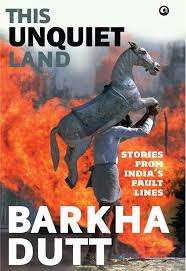
This Unquiet Land


      Author                        Barkha Dutt

      Country                      India

      Genre                          Non Fiction

      Publication Date        Dec 2015

      Pages                          297


Barkha Dutt has always been one of my favourite journalists. Like everyone else in her profession, there is much said about her, but to me, her personality, her attitude and just her ability to stand her own in a world of men has been inspirational! Hence, it's no surprise that with absolutely no background, l impulsively picked up this book as soon as it was published and infact, especially ordered my copy through India.

An interesting commentary on India is what this book provides. But unfortunately, it does nothing beyond. Written by someone like Barkha, it's a let down that the book has traded opinions for pure factual commentary. For anyone who has kept up to date with what's hot and happening in the Indian media, this book has nothing unique to offer. However, for the others it's a succinct accumulation of all that has happened in India over the last few years!

One of my favourite reflections from the book is the issue of feminism and how most women do disservice to this by trying hard to mimic male behaviour attributes in order to fit into a largely male dominated society. In the bargain, they unknowingly tend to forget their individuality and hence, go against the very reason, gender diversity is valued.

Another interesting discussion is the fact that terror attacks on India are becoming common place and we are at our most vulnerable position with two nuclear powered countries as our neighbours. Life carrying on post an attack is inadvertently attributed to the spirit of people, but in reality, it's really a combination of compulsion and fatalism.

Another key theme is the responsibility and the evolution of media; which Barkha has quite skilfully touched upon through the numerous topics of terrorism, riots, religion, feminism and others.

In summary, I would say that this is a fine book but is not what I had expected of Barkha!