Wednesday, 30 August 2017

Mister Pip


     Author                        Lloyd Jones

     Country                      New Zealand

     Genre                          Historical Fiction

     Publication Date        2006

     Pages                           256


This is an intriguing and enthralling story to say the least. Set in Papa New Guinea, on the island of Bougainville; against the backdrop of the nation’s historic civil war in 1991, this is the story of the 13 year old Matilda who lives on the island with her mother and hopes to have a better life in the future.

Through this short and poignant story, Lloyd Jones very artistically portrays the everyday struggles of the ordinary man, the desperate need for survival against all odds and the constant hope that the future will be better than the present. At the heart of the story, is the book “Great Expectations” and Mr Watts' deep urge to share his love for the book with the children on the island. And this is what particularly stands out for me about the book. The love for reading or rather for an unexplored world that Mr Watts creates in these children who have nothing better to do with their time, is exemplary. The below quotes are a true testimony to this:

“No one had ever told us kids to look there for a friend.”

“Mr Watts had given us another piece of the world. I found I could go back in as often as I liked.”


Matilda’s love for Pip (the central character of Great Expectations) and for the book in general is endearing.  She starts associating with Pip and with that harbours the hope that one day, things will change for her, just as they had changed for Pip.

“What did I hope for? Just hope itself, really, but in a particular way. I knew things could change because they had for Pip.”

The two characters that stand out for me in the book are that of Mr Watts and of Matilda’s mother. Mr Watts is shown as a simpleton, but a man of true character. Despite what the villagers hold against him, he doesn’t budge from teaching the children or from protecting them and the village. Matilda’s mother is a slightly more complex character. A huge believer in religion, she constantly misunderstands Mr Watts and his teachings, to the extent that she puts the entire village in jeopardy due to that. While on one hand, one would detest her for this, on the other hand, her true strength of character comes to life in the end when she ferociously protects her daughter at the cost of her own life.

“He said to be human is to be moral, and you cannot have a day off when it suits. My brave mum had known this when she stepped forward to proclaim herself God's witness to the cold blooded butchery of her old enemy, Mr Watts.”

This quote, for me, has a very deep meaning as it right says that being human means being moral and there cannot and should not be even one instant when one is not so.

The end of the book, as Matilda moves to join her dad in Australia signals the new life, the better life that she used to always hope for. As she matures and learns more about the world around her, she falls in love with Dickens and for her Dickens is the same as Mr Watts.

“My Mr Dickens has taught every one of us kids that our voice was special.”

“Pip is my story and the next day I would try where Pip had failed. I would try to return home.”


Friday, 4 August 2017

A Strangeness in my Mind


     Author                       Orhan Pamuk

     Country                     Turkey

     Genre                         Fiction

     Publication Date       Dec 2014

     Pages                          624


This is my first book by this award winning author and I can’t say anything more than the fact that I have enjoyed this immensely. The simplicity of his writing, the depth of his messages and the strengths of his characters will stay with me for a long time.
Set in Istanbul, against the backdrop of the wave of communism, this is the story of Mevlut and his life as a boza seller. Through the book, Orhan Pamuk very skilfully traces Mevlut’s transition from a young man who migrates to the city with his father to an old and mature Mevlut who relies on his boza selling walks as a means of calming his mind after his wife’s death. The simplicity of Mevlut’s life, his true love for his wife, Rahiya and his daughters is truly enchanting and endearing.
One of the central tenets of the book is boza selling.  On one side it reflects Turkish traditions which are being kept alive by boza sellers like Mevlut. On the other hand, the walks associated with selling boza give us a peek into Mevlut’s soul. These walks are nothing less than meditation for him: they are his windows to the world.
“Walking fuelled his imagination and reminded him that there was another realm within our world, hidden away behind the walls of a mosque, in a collapsing wooden mansion, or inside a cemetery.”
The purity of Mevlut’s soul and the simplicity of his life are truly appealing. Despite eloping with the wrong woman, the fact that Mevlut never lets Rahiya even get an inkling of that, is a true reflection of his character. He grows to become extremely fond of Rahiya and looks towards the time spent with her and his two daughters as the highest points of his life! When asked what he would do if he won the lottery, Mevlut simply responds: “I'd just sit at home with my daughter's and watch TV, nothing more.”
My most favourite part of the book is the ending; which is all encompassing and brings the story back to complete the full circle.  Mevlut does what he does best in the last chapter – walks around the city and sells boza. His reflections on life as he does this and the comments from passer-by’s congratulating him on keeping up an old tradition wind the story up beautifully. And no ending would have been perfect without Mevlut’s thoughts turning to Rahiya;
“I have loved Rahiya more than anything in this world”
These are the words that the book ends with and nothing could have done more justice to the ending that these words.
In summary, I have greatly enjoyed this book and would highly recommend this to one & all!


Tuesday, 30 May 2017

A Golden Age


     Author                         Tahmima Anam

     Country                       United Kingdom

     Genre                           Historical Fiction

     Publication Date         January 2009

     Pages                           276


A very interesting read - that is how I would define this book.

When I picked up this book, I was merely intrigued by the fact that being from the same sub continent, I had never really read about Bangaldesh's struggle for freedom. But it clearly proved to be much more than that! Against the backdrop of a new nation coming to life, this is a story that is packed with history, emotions and the beauty of relationships.

Rehana Haque is a young widow and "A Golden Age" portrays the story of her life and her family. As she is celebrating the coming of home for her two children, the country breaks into a war, sparked by Bangladesh's struggle for freedom. Being disconnected from politics and too involved in her own world, Rehana does not foresee how the war will change her and her children for ever! From someone whose world is limited to ensuring safety for her family, she soon evolves into a tiger mom who would go to any extent to protect her children. And this stands her in great stead throughout the book and particularly in the end!

Tahmima has done a tremendous job in capturing a variety of human relationships: relationship with one's child, siblings, friends and finally a romantic relationship. One of my best parts of the book is Rehana's growing maturity and coming of age; which brings her at the centre stage of the war. During this time, Rehnana also passionately battles with her romantic feelings when she comes in real close contact with someone other than her husband for the first time. And this is best captured through the following quote which truly portrays the hunger, pain and loneliness of her soul:

"In the midst of all the madness, I found the world seemed right for the first time in a very long time. I heard the song of a woman whose voice held a thousand years of sorrow."

What has touched me the most is the end of the book and how Rehana and her love for her children can go to any extent to protect them. What she does in the end left me bewildered and touched; to the extent that I had to go over the same page once twice! Rehana's closing line in the book is a true reflection of this and of the strength of her character:

"This war that has taken so many sons had spared mine. This age that has burned so many daughters had not burned mine. I have not let it."

In short, I will just say that this is a great read and you should surely add this to your bookshelf!


Sunday, 21 May 2017

Purple Hibiscus


     Author                    Chimimanda Ngozi Adichie

     Genre                     Historical Fiction

     Country                  Nigeria

     Publication Date    October 2003

     Pages                      307


I have this amazing long distance book club with a group of really close college friends and last month was the month of "Purple Hibiscus"; Chimimanda's debut novel.

Set against the backdrop of Nigeria and its military coup, this book explores domestic violence, religion, the urge for freedom and independence and the coming of age of the young 15 year old narrator and protagonist: Kambili.

Kambili and her elder brother, Jaja live a life of utmost discipline and schedule under the strict supervision of their father; who is a highly respected Catholic leader. To the outside world, he is a great man who helps one and all, but for his family he is a strict disciplinarian who very often uses physical violence against his wife and children. In this environment, Kambili has never known freedom, laughter, fun or even the ability to think for herself and make her own decisions.

Life then takes a somersault when the two siblings go to live with their aunt, Aunty Ifeoma and their stay there gets extended due to the precarious military situation in  the country. The contrast in Aunty Ifeoma's home environment from that of her own; is best reflected through the following quotes by Kambili:

"I was just observing a table where you could say anything at any time to anyone, where the air was free for you to breathe as you wished."

"Laughter always rang in Aunty Ifeoma's house, and no matter where the laughter came from, it bounced around all the walls, all the rooms."

Experiencing a life of freedom for the first time, Kambili doesn't know how to behave and she struggles to find her words. Over a period of time, she and Jaja both build warm relationships with their Aunty and cousins and start experiencing a completely new life.

To my mind, some of the key themes of the book are religion and its mask under which "Papa" disciplines his children, the impact of family environment on one's upbringing and more specifically, the impact of domestic violence and the role not just of the perpetrator but also of those around him who allow this to continue. And while its easy to judge the behaviours of others from a distance, its important to note that Jaja and mother's silence did have a significant role in all of this. And what is impressive and worth a mention is the fact that both realised this to a certain extent.

"His eyes are too full of guilt to really see me, to see his reflection in my eyes, the reflection of my hero, the brother who tried always to protect me the best he could. He will never think that he did enough, and he will never understand that I do not think he should have done more."

Silence is also widely used in the book and at some places, it breaks my heart to observe silence where one would wish someone spoke up and spoke against Papa.

The ending of the book with the following quote symbolises the longing for freedom and independence in Papa's absence:

"We'll plant new orange trees in Abba when we come back, and Jaja will plant purple hibuscus, too, and I'll plant ixora so we can suck the juices of the flowers."

In summary, this is a real fast paced book with some great messages at both an intellectual and an emotional level. Chimimanda has done a great job with this, inspiring readers like us and inviting us into her Nigeria!


Sunday, 7 May 2017

Gone with the Wind


     Author                      Margaret Mitchell

     Country                    United States

     Genre                        Historical Fiction

     Publication Date      May 1940

     Pages                        1031


'Gone with the Wind' has been on my 'to read' list for the longest time; but it is only recently that I finally found the courage and the passion to pick up this 1000 pages plus classic! And it was truly classic! One of my best books of all times...truly enchanting, engrossing and surprisingly fast paced for a classic!

Set in the American civil war of the 1860s, Gone with the Wind traces the life of Scarlett O'Hara, a bold and progressive protagonist. Scarlett is shown as a young girl, obsessed with her looks, boyfriends and having a good time but she soon matures into an aggressive and determined woman, hardened by the challenges that life has thrown at her. In the face of the war and its ensuing hardships, she effortlessly comes out of the shell of her protected life and dons an infallible persona, not just for herself, but also to protect her family and friends.

Being strong willed and determined, Scarlett unknowingly explores domains that have traditionally been reserved for men and by doing so, she challenges the very social fabric of the 19th century society. Establishing and running a business independently, working during her pregnancy are only some of the examples of what she does. And interestingly, none of her actions are an attempt to prove her worth as a woman but are merely an effort to earn money and never to be hungry again.

The below quote related to her by Rhett Butler, her friend and foe is quite apt in capturing the essence of Scarlett O'Hara and her personality.

"All you've done is to be different from other women and you've made a little success at it. That is the one unforgivable sin in any society. Be different and be damned ! The mere fact that you've made a success of your mill is an insult to every man who hasnt succeeded. A well bred female's place is in the home and she should know nothing about this busy, brutal world."

Scarlett's relationship with Rhett Butler, a rich but offensive middle aged man is both annoying and endearing. As the book evolves, this relationship matures from one of hatred, to interest, to indifference and finally to love and then to indifference once again. They are both unscrupulous and hence, relate very well to each other. Their ability to be honest with each other without a fear of judgement is the brightest spark of their relationship but unfortunately (to my romantic heart atleast), their love for each other wanes out towards the end of the book; leaving them both alone.

In short, Margaret Mitchell has done a great job in capturing not just the life and travails of Scarlett, the complexity of relationships, the beauty of human emotions but also the history, the war, its impact on civilisation and the desperation of times. One of the purest and most human emotions captured brilliantly through the book is the basic human need for survival and the courage that desire pumps into each of us. Scarlett's recurring quote "I do not ever want to be hungry again" is a great reminder of the same.

I will finally close by saying that reading 'Gone with the Wind' has been a treat like none other. I highly recommend this book to anyone who loves a good story packed with history, human emotions and impressive personalities..pick this up and you will not regret it!


Saturday, 18 March 2017

Being Mortal


     Author                        Atul Gawande

     Country                      United States

     Genre                          Non Fiction

     Publication Date        October, 2014

     Pages                           263


I have recently started a book club with my college friends and this was our first picks. Hence, it was very special to me! Having vaguely heard about this book before, I had never found the courage to pick this up (yes - you need courage to read a book!). But I am delighted to share that this was not only a great read, but also very enlightening and enriching.
 
Written by a medicine professional, "Being Mortal" is an interesting take on Medicine and Mortality. Through his book, Atul Gawande explores the fact that while the scientific advancements in medicine have done a great service by extending human longevity, they tend to make us forget that we are all mortal and life has to come to an end finally. There is a fine line between "fixing" issues, pushing limits and accepting the reality.

"Decline remains our fate, death will someday come" brings this to life very aptly.

Atul further explores the concept of independence and how a debilitating life, one which starts to lose independence is very hard for the aged. The idea of being dependent and losing your freedom is the very premise on which nursing homes are built and there is nothing more depressing than this for the aged.
 
The other key aspect of the book which rings a bell personally for me is that, even in old age, all humans are keen to have a purpose larger than themselves. As life debilitates through age, clinging on to a purpose and a meaning is very important to most, but the constant need of medicine and of old age care to focus solely on safety and health takes away from this purpose. What matters in life changes significantly as one nears the end, but the need for a "purpose" remains equally important or rather, to a certain extent, becomes more important.

Some of my best quotes from the book are:
 
"Medical professionals concentrate on repair of health,  not sustenance of the soul."
 
"We think our job in medicine is to ensure health and survival. But really it is larger than that. It is to enable well being. And well being is about the reasons one wishes to be alive."

In summary, this is a great book and I would highly recommend it to anyone who is up for a new and unique challenge!


Tuesday, 20 September 2016

The Blue Notebook


     Author                     James Levine

     Country                   India

     Genre                       Fiction

     Publication Date     2009

     Pages                        205


For me, its very simple. A book that makes me cry stays very close to my heart. And not many books do that. But "The Blue Notebook" did exactly that: it broke my heart and made me literally cuddle up in my blanket and cry. And hence its no surprise that I absolutely loved the book and can't recommend it enough. The only disclaimer would be that it is not for the faint hearted. If you have the courage to face up to a reality unknown to you; then this book is for you!

This is the story of a 15 year old Indian girl, Batuk who is sold into prostitution and slavery by her father at the age of 9. Over time, she comes to terms with this reality, makes the most of it and finds solace in penning down her thoughts in the "blue notebook" . The book, hence, is portrayed as a collection of her writings. The horrific details especially of her being raped and molested make this a very hard but a very real read.

I have particularly enjoyed the language and the style of writing. The deep rooted connotations along with the intriguing language make this book stand apart. The story flows seamlessly between the past and the present and this is another style that particularly interests me. The book is narrated in the language of the 15 year old protagonist, Batuk and she is both dramatic and cynical while being very astute and perceptive in her observations.

To me personally, what is most stark and heart wrenching is that Batuk's father is the one who sells her into prostitution. The disappointment that she feels when he leaves her there for the first time; followed closely by the terror she experiences the first time she is fondled by an "Uncle" are the 2 instances in the book when the beauty and complexity of human emotions are at the peak. Having said that, the resilience of Batuk's spirit is a lesson to all of us. Her fear that she is losing her identity and her thoughts force her to put pen to paper and interestingly; this is what helps her survive.

Some of the quotes from the book that stand out for me are:

"As I observed the depth of my father's weakness, our gazes touched and from him I felt the kiss of inner death"

"Initially, making sweet cake was not something I tried to excel at. I viewed my baking as a means of survival"

"I am a simple baker of sweet cake"

In conclusion, this is one of the best books I have read in recent times and couldn't recommend it enough. The brilliance and the elegance with which the story is told make it hard to believe that this is the work of someone who is alien to the country and this life style. James has done a remarkable job and couldn't be commended enough!

As I leave this book and move on, what has stayed with me  is a fundamental question on how a father could do this to his daughter? I try hard not to judge; but in this instance I can't help but do exactly that...


Wednesday, 31 August 2016

Dear Life


    Author                         Alice Munro

    Country                       Canada

    Genre                           Fiction (Short Stories)

    Publication Date         212   

    Pages                            319


While I love fiction, I have never been particularly fond of short stories. And interestingly, I haven't been able to articulate the reason for this very well even to myself, until recently. And the reason is as simple and basic as the fact that short stories tend to leave me as a bystander. They don't welcome me fully into the centre of the story. This is something that a gripping book easily does and something that I derive my energy and passion for books from!

Hence, despite my reservations as stated above, I voluntarily picked up this book by Alice Munro. Alice Munro is a very well known and award winning author (incidentally, this book has won the Man Booker International Prize)  and since she writes only short stories, I didn't think I had too much of a choice than finding myself in the company of my not very best friends (in the form of short stories).

Unfortunately, as I moved from one story to the other, my experience with Alice Munro and her work hasn't changed my opinion on short stories; but rather only reinforced it.

Having said that, the stories are surely well written and the beauty of story telling lies in the fact that the plot evolves slowly; it almost unfolds with great dexterity. I consider this to be one of Alice's landmarks; not stating the facts at the start of the story; but allowing it to evolve as one traverses through the story. However, there is not too much punch in the stories and there isn't enough novelty in one story from the other. Most stories, while they are emotional and well written, end up being quite similar in their build up and final ending. Being biased as I am towards award winning  books, I tried hard to keep myself entertained from one story to the other, but failed terribly.

Hence, in summary, while to someone who enjoys short stories, this would have been an interesting piece of work, for me, it was nothing out of the ordinary and infact I was left questioning the basic premise due to which I picked up the book - that Alice Munro is supposedly the best story teller of her time.

Yes, that might be harsh but as a consumer and an avid one at that, that's my opinion!


Sunday, 7 August 2016

The Unbearable Lightness of Being


     Author                           Milan Kundera

     Country                         France

     Genre                             Philosophical Fiction

     Publication Date           1984

     Pages                              305


This is quite a different book from what I have read mostly. And a little bit uncomfortable at that. A free flowing, well connected fiction is what typically appeals to me but Milan Kundera's work is surreal, philosophical and pretty disconnected to say the least. Having said that, it is quite intriguing and that is what has stayed with me.

The Unbearable Lightness of Being is the story of Tomas, his wife Teraza, his mistress Sabina and their beloved dog Karenin. As the name explains beautifully, Tomas believes in a life that is light, unattached and unbound. His mind differentiates exquisitely between body and soul and what is infidelity to Tereza is just a way of life and a way of being to him. The enchanting Tereza who strives for something higher in life believes in love and the beauty of chance encounters. As the book evolves, she matures from being hurt and disappointed at his infidelities to accepting it while striving to create a life with him. Tomas, while he enjoys himself with Sabina, truly and deeply only loves Tereza; beyond all physical love.

Some of the quotes which reflect the true flavour of the book are:

"She took things too seriously, turning everything into a tragedy, and failed to grasp the lightness and amusing insignificance of physical love."

"Hadn't he told her time and again that love and sexuality had nothing in common?"


"Her soul had lost its onlookers curiosity, it's malice and pride; it had retreated deep into the body again, to the farthest gut, waiting desperately for someone to call it out"

"Any schoolboy can do experiments in the physics laboratory to test various scientific hypothesis. But man, because he has only one life to live, cannot conduct experiments to test whether to follow his passion (compassion) or not."

Personally, to me this is a book more about philosophical reflections than about anything else. It's different characters and their varying paradigms forces one to suspend moral judgements (something we are all given to) and learn to accept things as they are...in their pure and light form; without taking them too seriously - "The Unbearable Lightness of Being"


Thursday, 23 June 2016

Looking Away


     Author                            Harsh Mander

     Country                          India

     Genre                              Non Fiction

     Publication Date            April 2015

     Pages                              426


This book has often been defined as a book that every thinking Indian should read and I couldn't have found a better way of expressing my absolute reverence for this piece of real work. All of us who are closely associated with India tend to assume that we know a lot about this land which we claim as our own; but Harsh Mander has done a brilliant job of showing us the mirror. Grappling with feelings of shame, anger, disbelief and embarrassment to name a few, I finally made it through the book and am glad to be a wee bit richer in my opinions as a result of this tumultuous journey.

The book is built across a couple of key messages ranging from the state of the Indian poor to the legitimisation of our deep rooted prejudices and finally a call for public compassion. The way we treat our help, the existence of untouchability even in today's day and age, the caste divide, homelessness, the bias against Muslims, the sky rocketing medical costs pushing people into poverty are some of the myriad issues that Harsh has touched and left an indelible impression with.

While one really has to read the book to even gauge what I am trying to imply; some of the below quotes from the book do give a flavour:

"We don't care because we are unequal, and because we don't care, inequality will persist."

"One of the leading contributors to poverty is the rising cost of healthcare. The world bank estimates that one quarter of all Indians fall into poverty as a direct result of hospitalisation."

"To be poor in India is a crime. To be poor and also gravely ill is a crime deserving only the death penalty."

Personally, for me what had been hugely reassuring is Harsh's assertion that most of the things that he is demanding are not utopian but a basic human right. While we can debate endless about the market economy and how that should be allowed to take its due course, as Harsh says there is a floor of human dignity below which no individual should be allowed to fall. And no case for market led growth can justify that. Interestingly, Harsh goes to the extent of comparing poverty related deaths in the country to mass genocide by the state.

On a personal note, while I do consider myself a reasonably empathetic individual, sometimes the extent of issues that abound India numb us and make us immune to what we can really do to make a difference. As I look back at this book, my personal take away is that if we consciously start changing the social environment around us, India still has a lot of hope and promise!


Sunday, 29 May 2016

Colorless Tsukuru Tazaki


     Author                     Haruki Murakami

     Country                   Japan

     Genre                      Fiction

     Publication Date     April 2013

     Pages                      298


Another Haruki Murakami book that I am absolutely in love with. Some people define him as an exquisite artist and I couldn't agree more. Each book of his that I have read has been a notch better than the one before and that leaves me immensely grateful for such brilliant literature and the opportunity to savour it.

In this book, Haruki Murakami deals with themes of alienation, loneliness and insecurity exceedingly well. This is the story of Tsukuru Tazaki and his group of 4 close friends. During school days, they happen to meet by chance and form a really close relationship. As time passes, one day, these 4 friends suddenly severe their ties with him without giving any concrete reason. This leaves the already insecure and under confident Tsukuru shattered. His life, which was till now centered around these relationships becomes meaningless. Through the course of the book, Haruki traces Tsukuru's travails with this emotional rejection and how, encouraged by his girlfriend he finally decides to deal with it head on and resolve this long overdue emotional issue.

When I reflect on this book and some of its subtle but deep messages; what stays with me is Tsukuru's sense of self and how that is impacted by his constant internal dialogue. This is best brought to life through:

"There must be something in me, something fundamental, that disenchanted people. Maybe I am fated to be alone"

Another strong theme through the book is Tsukuru's insecurity and his constant fear that he would be left alone one day.

"He loved his four friends, loved the sense of belonging he felt when he was with them. Like a young tree absorbing nutrition from the soil, Tsukuru got the sustenance he needed as an adolescent from this group. Still, he had a constant, nagging fear that someday he would fall far away from this intimate community, or be forced out and left on his own"

Finally, as happens in most such cases, Tsukuru spends most of his adult life as insecure, scared and emotionally empty and that takes a toll of his life. His inability to form intimate relationships is a true reflection of this.

"I might have been afraid that if I really loved someone and needed her, one day she might suddenly disappear without a word, and I'd be left all alone."

Personally, I have been hugely impacted by this book and have started thinking about these issues in a completely different light since having read the book. The subtlety and softness with which these hugely complicated themes are conveyed are a true testament to Haruki Murakami's ability as an author.

In summary, I can't thank my friend Yosha enough for introducing me to Haruki Murakami and his work!


Wednesday, 20 April 2016

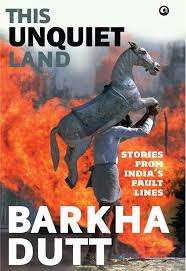
This Unquiet Land


      Author                        Barkha Dutt

      Country                      India

      Genre                          Non Fiction

      Publication Date        Dec 2015

      Pages                          297


Barkha Dutt has always been one of my favourite journalists. Like everyone else in her profession, there is much said about her, but to me, her personality, her attitude and just her ability to stand her own in a world of men has been inspirational! Hence, it's no surprise that with absolutely no background, l impulsively picked up this book as soon as it was published and infact, especially ordered my copy through India.

An interesting commentary on India is what this book provides. But unfortunately, it does nothing beyond. Written by someone like Barkha, it's a let down that the book has traded opinions for pure factual commentary. For anyone who has kept up to date with what's hot and happening in the Indian media, this book has nothing unique to offer. However, for the others it's a succinct accumulation of all that has happened in India over the last few years!

One of my favourite reflections from the book is the issue of feminism and how most women do disservice to this by trying hard to mimic male behaviour attributes in order to fit into a largely male dominated society. In the bargain, they unknowingly tend to forget their individuality and hence, go against the very reason, gender diversity is valued.

Another interesting discussion is the fact that terror attacks on India are becoming common place and we are at our most vulnerable position with two nuclear powered countries as our neighbours. Life carrying on post an attack is inadvertently attributed to the spirit of people, but in reality, it's really a combination of compulsion and fatalism.

Another key theme is the responsibility and the evolution of media; which Barkha has quite skilfully touched upon through the numerous topics of terrorism, riots, religion, feminism and others.

In summary, I would say that this is a fine book but is not what I had expected of Barkha!


Monday, 4 April 2016

Americanah


     Author                     Chimamanda Ngozi Adiche

     Country                   Nigeria

     Genre                       Fiction

     Publication Date     May 2013

     Pages                        477


I have been looking for a good book to read for a while now. Recommended by a dear friend, this award winning book did meet that basic expectation but didn't go much beyond. An interesting and insightful read, but not one of my best books ever!

Set in Nigeria under military dictatorship, this is the story of a young girl, Ifemelu who falls in love with Obinze, while studying and spending most of their childhood time together. As time passes, their lives choose different paths and Ifemelu finds herself in America while Obinze, desperate to get out of Nigeria and unable to get a visa to his most admired and fantasised country, America, finds himself in London. Through her struggles with racism and her efforts to establish herself successfully in the tough American world, Ifemelu snaps her ties with Obinze and with the rest of her past. As time progresses, both of them once again find themselves in their homeland, faced with one of the toughest decision of their lives. Torn between right and wrong, between passion and commitment, they try to ask the questions and seek the answers.

It would be fair to say that Chimamanda has done a remarkable job at stringing together a passionate story about love, relationships and race in the new globalised world. What have particularly stayed with me are her reflections on racism and the complexity and beauty of human relationships as portrayed through the book.

It would be suffice to say that Americanah has been a welcome entrant into my reading and blogging club and I am happy for it!


Saturday, 5 March 2016

An Empty Room


     Author                        Talitha Stevenson

     Country                      United Kingdom

     Genre                          Fiction

     Publication Date        2005

     Pages                           218


An interesting and fairly quick read is how I would describe this not very well known book. I happened to pick this up on a chance at a random bookstore while on holiday and it turned out to be a pleasant surprise.

The book traces the life of a young girl, Emily who is busy spending her time with her handsome and charming boyfriend, Tom while getting wasted in bars. Coming from slightly broken and disconnected families, both Tom and Emily seem to be pretty similar in their approach to life and hence get along well. As the story progresses, Emily happens to fall for Tom's married cousin, Simon. Talitha then traces the illicit relationship between Emily and Simon and the consequences it would have for both families.

While the storyline is not particularly unique, some of the themes espoused through the book are powerful and make for a meaningful read. One of the themes that stands out for me personally is how each of us is a product of the circumstances and experiences of our formative years. Complex childhoods very easily make for insecure and complex adult lives. Another powerful thought that stays with me is how we are all prone to quick judgements and  we would do ourselves and each other much service if we don't judge the choices others make in their life. Pure acceptance (the absence of judging) is a goal we should all aspire to achieve!

Some of my favourite quotes from the book are:

'Promises matter, but happiness matters more'

'If you give your heart to someone and they choose not to take it, you never really get it back'

I would recommend this book to anyone who is looking for a quick and meaningful read!


Thursday, 28 January 2016

Dealing with People you Can't Stand


     Author                    Rick Brinkman & Rick Kirschner

     Country                  United States

     Genre                      Management

     Publication Date    1994

     Pages                       224


I am not a huge fan of management books and hence more often that not, I end up staying away from them. Having said that, I sincerely want to and try to read them once in a while but unfortunately, I don't really get the same motivation for them as I do for my beloved fiction!

And hence its no surprise that I had no plans to pick this up till a friend literally gave me the book and told me to read it!

But I have absolutely no regrets at blindly following her advice!

This was a quick read with some interesting insights. And in my view, the best part of this book is its name. Being what it is, it is hardly discreet and it's amusing to see how those around you get worried with you reading this! (For the longest time my husband was insecure with this book on my bedside!)

As the title suggests, at various points of time in life (more often than we would like to), we have to deal with people whom we don't necessarily like. And through this book, the authors help us identify who these people are, why they are behaving the way they are and what really can be done in order to deal better with them. The categorisation of people really rings a bell for me personally and as I read through the descriptions, I couldn't help but think of different people for each categorisation. Moving on from categorisation, the book then helps us identify the intent behind each of the behaviours and how depending on which intent is threatened, one tends to take on a different role. And the crux of dealing with such situations really lies in identifying this intent. The better we are at pulling ourselves back from the real situation and at identifying the intent, the better will we be at dealing with the situation. And while this sounds simple and obvious, it is indeed very powerful when conscientiously implemented.

In summary, I would suffice in saying that this is an interesting read and really worth one's while. For anyone who is interested in learning about how to deal with people, this would be a highly recommended read.


If you are thinking of purchasing a copy of this book, try out my favorite site: www.lafalafa.com; an online shopping portal which brings together some awesome deals from all large e commerce sites (Flipkart, eBay, Snapdeal and the likes) while also offering additional cash back; which you only get if you go through Lafalafa and shop at any of your e commerce sites!  
You could use the link: http://bit.ly/1MJ4Fh5 to shop.

So, do check it out and Happy Reading! 

Saturday, 19 December 2015

Why Should Anyone be Led by You?


     Author                      Rob Goffee & Gareth Jones

     Country                    United States

     Genre                        Management

     Publication Date      2006

     Pages                        217


If you are looking for a management book that's real and authentic, then this could easily be your pick! The fact that this is far removed from any standard leadership theories makes it easily relatable; thereby striking an instant chord. And the title of the book: 'Why should anyone be led by you?' triggers enough curiosity to make one pick up the book.

The authors have done a commendable job in very simply defining true leadership. And this statement of mine is really an oxymoron since the very essence of the book is that there is really no definition of leadership and one has to do what works best for him. 'Being yourself' is a powerful theme in the book. Managing inherent tensions like 'being authentic while conforming enough'; 'establishing intimacy while maintaining a distance' is another core theme espoused by the book.

While there are a number of key messages, personally for me what has been a huge insight is the fact that while it's important to retain one's authenticity, one really does need to conform enough, especially in the beginning to  establish oneself in an organisation.

Another interesting insight for me was the entire concept of work life balance and how according to the authors, it's not just about spending more time at home but rather about transforming workplaces into arenas that allow for the display of authenticity. That, to me, is a really fresh way of looking at the concept of work life balance.

Like I have shared before, I am definitely not a fan of management books but reading this one has definitely been a fresh and enriching experience!


If you are thinking of purchasing a copy of this book, try out my favorite site: www.lafalafa.com; an online shopping portal which brings together some awesome deals from all large e commerce sites (Flipkart, eBay, Snapdeal and the likes) while also offering additional cash back; which you only get if you go through Lafalafa and shop at any of your e commerce sites!  

So, do check it out and Happy Reading! 

Tuesday, 17 November 2015

The Cairo Trilogy


     Author                      Naguib Mahfouz

     Country                    Egypt

     Genre                        Historical Fiction

     Publication Date      1957

     Pages                        1325


'One of the best books I have read in recent times': that's how I would like to describe this book. With some 1300 plus pages, its crazily long but honestly, that's one of the best parts of the book! I have never been a huge fan of short stories and now I know why. Novels or books that are as long as this grow on you and absorb you as an insider. And that is what, it my view, makes the reading experience truly intense and powerful!

The Cairo Trilogy traces the life of a traditional family in Egypt across three generations. Al-Sayyid Ahmad Abd al-Jawad is the tyrannical patriarch who rules his household with a strict hand while leading a secret life of self indulgence. The story of this family and it's upheavals  is beautifully interspersed with that of Egypt and its turbulent times.

Through this Nobel prize winning trilogy, Naguib Mahfouz brings to life the themes of family values, traditions and religion, to name a few. Another key theme that is subtly conveyed through the book is the superiority of man over woman. And it's refreshing to see how this is not presented with any judgement, but is rather factually conveyed as a mere reflection of the times. Some quotes that really bring this to life for me are:

'You're just a woman, and no woman has a fully developed mind'

'Zaynab was asking for a divorce. Which of them was the man and which the woman? There was nothing strange about a man casting away a pair of shoes, but shoes were not supposed to throw away their owner'

How women don't even consider most of these circumstances as derogatory since they have not known anything better is another interesting insight for me.

Another powerful and beautifully portrayed theme in the book is the passage of time and how that influences and moulds us along the way. As time passes and Al-Sayyid Ahmad matures from a young man with a secret life of indulgence into an old man, he becomes very different. His wife, Amina who loses her beloved son at a very young age also learns to accept fate and to allow time to take its due course. And this passage of time and its reflection on us as individuals is portrayed through each character and their independent journeys.

In short, The Cairo Trilogy is filled with drama, humour, reality, traditions, history and most essentially a flavour of having been crafted by an excellent artist. And it's no wonder that this won the Nobel Prize.

Personally, I would highly recommend this book to anyone who loves fiction and has the courage to take on a 'massive' book!


If you are thinking of purchasing a copy of this book, try out my favorite site: www.lafalafa.com; an online shopping portal which brings together some awesome deals from all large e commerce sites (Flipkart, eBay, Snapdeal and the likes) while also offering additional cash back; which you only get if you go through Lafalafa and shop at any of your e commerce sites!  
You could use the link: http://bit.ly/1MJ4Fh5 to shop.

So, do check it out and Happy Reading! 

Thursday, 15 October 2015

An Artist of the Floating World


     Author                          Kazuo Ishiguro

     Country                        United Kingdom

     Genre                            Historical Fiction

     Publication Date          1986

     Pages                             206


I have read a few books by Kazuo Ishiguro but the most memorable amongst those have been 'Nocturnes' and 'Never let me go'. On account of my extremely positive experience with these books; this Booker prize winning author has been a little special to me: his unique style with a little stroke of Japanese is something that has always stayed with me; way beyond the written word!

And it is with exactly these expectations that I picked up another one of his books: 'An Artist of the Floating World'. But as they say, high expectations lead to disappointments and that's exactly what happened here. There is no denying that this is a good book of its own accord but it surely falls short of the Kazuo Ishiguro league! I recognise that this may not be fair to the author or to the book, but such is life and the trap of expectations that it lays for us.

Set in post war Japan (1948), 'An Artist of the Floating World' traces the life of the celebrated painter, Masuji Ono and his coming to terms with the reality of the new Japan. What should have been a tranquil retirement with tasks such as attending to the garden, house repairs, his daughters and grandson, drinking with old friends; turns into an unsettling phase with constant reflection on the past and the beautiful times gone by.

Through the course of the book we see how Masuji can't help but reminiscence about the past and this constant going back is indeed one of the central themes of the book. Our inability to snap completely free from our past is what binds us down and keeps us from moving ahead. And that's perfectly portrayed through the character of Masuji. I can't help but reflect that life would have been so much simpler if we had the ability to just snap free but guess; its this inability that makes us human vs machines.

One of my favourite quotes from the book on the above theme is:
'That little world has passed away and will not be returning. The old district was dear to her heart - much of her life and energy had been invested in it - and one can surely understand her reluctance to accept it has gone forever.'

Another significant focus of the book and my personal take away is how the world of art plays a pivotal role in formulating public opinion; esp. in an evolving society. Masuji's reflection on his pieces of work and those done by his peers, students and others and how they influenced a maturing Japan bear testimony to the above.

In summary, while the book is not a perfect Kazuo Ishiguro book, it does have some interesting and insightful themes and what I have particularly liked is the fact that it ends on a rather optimistic note:
'To see how our city has been rebuilt, how things have recovered so rapidly over these years, fills me with genuine gladness.'

In summary, while this is not as good as I had expected it to be, I would encourage you to read it to find out for yourself!


If you are thinking of purchasing a copy of this book, try out my favorite site: www.lafalafa.com; an online shopping portal which brings together some awesome deals from all large e commerce sites (Flipkart, eBay, Snapdeal and the likes) while also offering additional cash back; which you only get if you go through Lafalafa and shop at any of your e commerce sites!  
You could use the link: http://bit.ly/1MJ4Fh5 to shop.

So, do check it out and Happy Reading! 

Tuesday, 22 September 2015

The Prophet


     Author                            Kahil Gibran

     Country                          Lebanon

     Genre                             Poetry

     Publication Date           1923

     Pages                             80           


This book is an amazing collection of simple and intuitive life concepts. There is no better way to review this than by providing a flavour of some of its best quotes!

Marriage
Sing and dance and be joyous together, but let each one of you be alone.

Children
You may house their bodies but not their souls, for their souls dwell in the house of tomorrow, which you cannot visit, not even in your dreams.

Clothes
Forget not that the earth delights to feel your bare feet and the winds long to play with your hair.

Buying and Selling
It is in exchanging the gifts of the earth that you shall find abundance and be satisfied. Yet unless the exchange be in love and kindly justice it will but lead some to greed and others to hunger.

Crime and Punishment
I say that even as the holy and the righteous cannot rise beyond the highest which is in each of you, so the wicked and the weak cannot fall lower than the lowest which is in you also.

Freedom
You shall be free indeed when your days are not without a care nor your nights without a want and a grief, But rather when these things girdle your life and yet you rise above them naked and unbound. You can only be free when you cease to speak of freedom as a goal and a fulfillment.

Teaching
No man can reveal to you aught but that which already lies half asleep on the dawning of your knowledge.

Friendship
Let there be no purpose in friendship save the deepening of the spirit.

Talking
You talk when you cease to be at peace with your thoughts. In much of your talking, thinking is half murdered.


If you are thinking of purchasing a copy of this book, try out my favorite site: www.lafalafa.com; an online shopping portal which brings together some awesome deals from all large e commerce sites (Flipkart, eBay, Snapdeal and the likes) while also offering additional cash back; which you only get if you go through Lafalafa and shop at any of your e commerce sites!  
You could use the link: http://bit.ly/1MJ4Fh5 to shop.

So, do check it out and Happy Reading! 

Sunday, 16 August 2015

Go Set a Watchman


     Author                       Harper Lee

     Country                     United States

     Genre                         Fiction

     Publication Date       July 2015

     Pages                          278


I am not one to pass strong judgements but guess a book review blog wouldn't be worth much if one didn't do that. And hence, my two cents worth on this book is that it's highly avoidable and definitely not worth your time and money. Just as some things are best left unsaid; I would venture that some books are best left unwritten. Once written, they unfortunately do significant disservice (especially to their highly acclaimed prequel) and that's exactly what has happened here.

Harper Lee's much hyped and awaited book 'Go Set a Watchman' builds on the same themes as the original and strives to weave together a compelling story. The characters are the same; having matured with time and age. While the issues raised in the book are as powerful as the original 'To Kill a Mocking Bird', the way it's been brought together leaves much to be desired.

Jean Louis is portrayed as a strong willed and independent young woman who has her own points of view and is not afraid to confront her once revered dad "Atticus" on what she believes is unfair and unjust. Her coming to terms with the reality of her dad not being a super human but being humanly flawed just like the others is one of the central themes of the book. The evolution of her relation with Atticus and how she finally accepts him for who he is and forgives him for weaving a perfect world for her child eyes is well depicted through the story.

Some of my favourite quotes from the book that bring these themes to life are:

"Had she insight, could she have pierced the barriers of her highly selective, insular world, she may have discovered that all her life she had been with a visual defect which had gone unnoticed and neglected by herself and by those closest to her; she was born colour blind"

"You confused your father with God. You never saw him as a man with a man's heart., and a man's failings - I'll grant you it may have been hard to see, he makes so few mistakes, but he makes them like all of us. You were an emotional cripple, leaning on him, getting the answers from him, assuming that your answers would always be his answers."

Despite the above seeming powerful inserts, on the whole, the book was really hard to get through and had it not been for my persistence to finish any book I start, I wouldn't have been able to accomplish this!

In a snapshot, I would describe this book as one with a powerful theme but repetitive story line and much talked of issues. And definitely not worth being mentioned in the same breath as 'To Kill a Mocking Bird'.


If you are thinking of purchasing a copy of this book (while I am not sure you are; after this review!), try out my favourite site: www.lafalafa.com; an online shopping portal which brings together some awesome deals from all large e commerce sites (Flipkart, eBay, Snapdeal and the likes) while also offering additional cash back; which you only get if you go through Lafalafa and shop at any of your e commerce sites!  
You could use the link: http://bit.ly/1MJ4Fh5 to shop.

So, do check it out and Happy Reading!